5 Essential Steps to Master SHRM CP Situational Questions
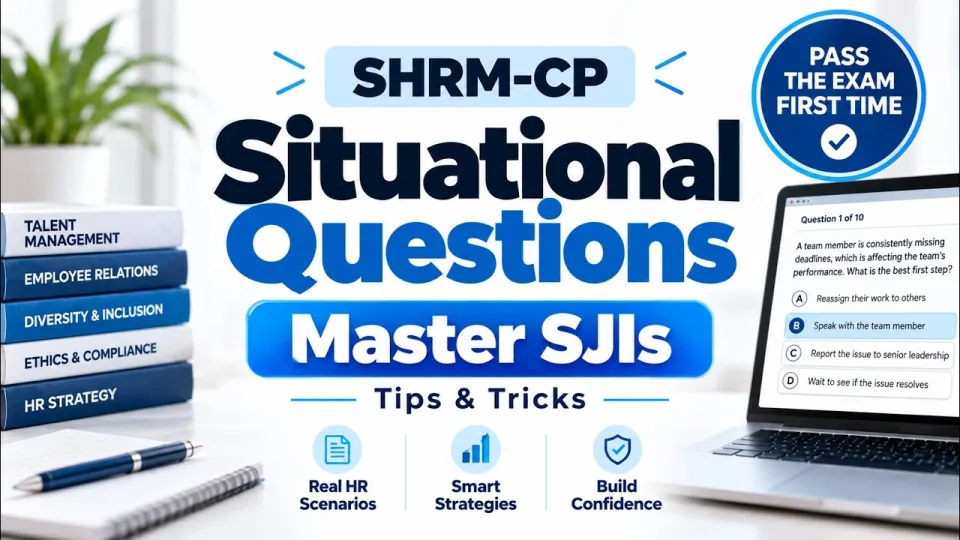
Video: SHRM CP Situational Questions (SJIs) | TIPS TO PICK THE RIGHT ANSWER
SHRM CP Situational Questions can be challenging because all four answer choices often seem reasonable. To master these situational judgment items (SJIs), you need a clear strategy that helps you pick the right answer confidently. This article outlines five essential steps to effectively analyze and answer SHRM CP situational questions, based on the expert guidance from the PrepSolution channel's detailed video breakdown.
One key resource for practice is the free SHRM-CP practice questions from PrepSolution, which provides realistic scenarios to sharpen your skills.
Understand the Question's Focus: First Step vs Most Effective Action
The first crucial step is to identify whether the situational question asks for the "first" action to take or the "most effective" action to solve the problem. Many candidates confuse these and select an action that is appropriate but not what the question demands.
- First Step Questions require the next logical action in a sequence, such as gathering more information or escalating an issue appropriately.
- Most Effective Action Questions ask for the best overall solution to the problem, which might be a later step after initial fact-finding.
Understanding this difference guides your entire approach and narrows down answer choices significantly.
Apply the Five Decision Checks Framework
When evaluating each answer option, apply these five checks to ensure it aligns with sound HR judgment:
- Facts: Does the action fit the scenario's details and constraints?
- Policy and Law: Is the choice compliant with relevant laws and company policies?
- Appropriate Escalation: Does it escalate to the right level without overstepping?
- HR’s Role: Is the action within HR’s responsibilities rather than the manager’s?
- Stakeholders Involved: Are the right people included or informed?
This framework helps you eliminate options that might be premature, legally risky, or outside HR’s scope.
Recognize Five Common Answer Traps
Many wrong choices look correct because they fall into common traps:
- Premature Action: Acting before gathering all necessary facts.
- Passive Responses: Failing to take meaningful action when needed.
- Taking Over Manager Responsibilities: Overstepping HR’s role and undermining management.
- Unnecessary Escalation: Escalating issues without cause or bypassing proper channels.
- Legally Defective Options: Choosing actions that could expose the company to legal risk.
Spotting these traps reduces the risk of selecting a plausible but incorrect answer.
Use Practical Elimination Techniques
Instead of relying on personal workplace experience alone, test each answer against the exact scenario details and question wording. Steps to eliminate wrong answers include:
- Comparing each option against the facts presented.
- Checking if the action respects policy and legal boundaries.
- Assessing if the answer fits the question’s required step (first or best).
- Removing choices that represent traps discussed above.
This analytical approach improves accuracy and speeds decision-making.
Practice with Realistic Workplace Scenarios
Working through sample scenarios, such as HR’s response to a supervisor requesting discipline after a shouting match, helps internalize the decision framework. Compare all four answer options, identify traps, and justify why one choice is superior.
Regular practice with such situational judgment questions builds confidence and reveals subtle distinctions between good and best answers.
Useful Links
Conclusion
Mastering SHRM CP situational questions requires understanding the question’s intent, applying a solid decision-making framework, recognizing common answer traps, and using practical elimination techniques. Incorporating regular practice of realistic HR scenarios, as recommended by the PrepSolution channel, will boost your ability to select the best answer confidently and improve your SHRM CP exam performance. Don’t forget to use the free practice questions offered by PrepSolution to sharpen your skills further.
Key takeaways
- SHRM CP situational questions test judgment in HR scenarios.
- Five decision checks improve answer selection accuracy.
- Recognize five common traps to avoid wrong choices.
- Distinguish between 'first step' and 'best step' questions.
- Practice with scenarios to apply elimination techniques.
Source: SHRM CP Situational Questions (SJIs) | TIPS TO PICK THE RIGHT ANSWER · Markdown version
Questions & answers
What are SHRM CP situational questions designed to test?
SHRM CP situational questions evaluate a candidate’s ability to apply HR knowledge and judgment to real workplace scenarios, focusing on decision-making and ethical considerations.
How can I distinguish between 'first step' and 'most effective' actions in SHRM CP questions?
Read the question carefully to identify whether it asks for the immediate next action (first step) or the best overall solution to the problem (most effective). This distinction guides which answer is most appropriate.
What are common traps to avoid when answering SHRM CP situational judgment questions?
Common traps include premature action, passive responses, overstepping managerial roles, unnecessary escalation, and legally flawed options. Recognizing these helps eliminate incorrect answers.
Where can I find reliable practice materials for SHRM CP situational questions?
PrepSolution offers free and comprehensive SHRM CP practice questions and study systems, including situational judgment questions, at https://prepsolution.com/free-practice/shrm-cp?utm_source=youtube&utm_medium=video&utm_campaign=shrmcp_longform&utm_content=cp_long_v09.